
BACKGROUND
Approximately 2005, I began receiving calls and observing some excessive and troubling behavioral characteristics in puppies. The first few calls I got were all from owners who reported incredibly excessive biting and mouthiness in the pups, to the point of feeling frightened of their 10 or 12 week old puppies. They would all say, “I know it sounds crazy, but you have to see this to believe it.” I did, and they were right. Over the top, frantic mouthiness, and with those sharp, baby teeth, thoroughly capable of doing damage.
I began sharing this information with our national network of trainers, and other dog pros around the country. As we exchanged information over a three year period of time, a very distinct profile began to emerge, which I dubbed Five Week Puppy Syndrome™, the reason being that all of the puppies who had characteristics of this developmental behavioral syndrome had been removed from either contact with the dam, and/or the siblings, or both prior to 8 weeks of age. The closer to 5 weeks of age the removal or separation was, and the more complete the separation, the more acute the symptoms. Not all of the puppies exhibited all of the signs and symptoms, but all of them seemed to exhibit at least three of the characteristics. The better the genetics, the less impact the separation between 6-8 weeks, but if the separation happened before 6 weeks of age, genetics usually wasn’t enough to rescue the pup from developmental chaos.
For example, the pup who modeled for the very first article on this syndrome was a five month old Golden Retriever pup, who was sold at 6.5 weeks. Best case scenario he came out of the litter at 6.5 weeks, but based on the behavior more likely at the end of week 5 or the beginning of week 6. He came in to training for excessive mouthiness including biting of the owner, leaping up and eating the leash on walks, leaping all over people, – I mean launching from five feet out at your mid body like a hurtling missile, not just silly GR jumping, and very intolerant to touch. Typical red flags of the developmental syndrome.
What also became clear, were that there were geographic pockets of these problems happening. States that had legislation regarding the sale of puppies before 8 weeks of age, had markedly less of these problems. Some of our colleagues had never heard of these kinds of profiles. Others wrote in, “Oh my God, you’re describing what I’m seeing exactly.”
In addition, as we began doing in depth investigation of adult problem dogs, particularly adult aggressive problem dogs, (either people aggressive or dog aggressive), and finding out their histories, specifically information about litter separation information where possible, we found that these symptoms continued unabated into adult life. Even good, balanced training was often not enough to diminish these behavioral tendencies. Absent specific behavioral intervention, and certain specific steps of rehabilitation, unwelcome and incredibly persistent behaviors clouded the behavioral profile, and did not fade.
On the bottom end of the scale, the more scrambled the genetic puzzle in the dog, particularly where there were multiple competing drive tendencies, for e.g., a retriever x bully breed; a guarding dog breed x herding x retriever; the more scrambled the brain of the Five Week Puppy Syndrome™ dog. Finally, the more conformational and structural defects factored into the equation, the more astronomically distorted the behavioral profile became to the point of irretrievable behavioral breakdown requiring euthanasia.
Conversely, dogs who managed to be pleasant, happy campers despite these developmental and genetic strikes against them, were keepers indeed, for their personalities emerged intact through a sea of debris. Such Five Week Syndrome successes were very rare, and most of them tended to be dogs from well-bred purebred working lines (whether small dog or large) no further away than one generation with strong, balanced conformation.
The closer to that MINIMUM magic developmental number of 8 weeks in the litter with both dam and siblings, the less the developmental impact of separation. The distinct nature of the developmental characteristics from 5 weeks to 8 weeks, and the contribution that the dam and siblings play (leaving aside for the moment other dogs) is so significant that you can just about date with eerie precision the age of separation of a pup by their behavioral profile.
FIVE WEEK PUPPY SYNDROME™ PROFILE
The profile continues to emerge, but here is a rough characterization of what we have seen, with the key in all the behaviors being their incredible persistent quality. A caveat. Not all dogs who exhibit these behaviors are “Five Week Puppy Syndrome™” puppies or dogs, but ALL DOGS REMOVED FROM THE LITTER AT FIVE WEEKS OF AGE absent extraordinary intervention (see below) will exhibit developmental chaos. Nothing we can do will ever totally make up for the lack of what nature does during those developmental weeks. We can and now have repeatedly bring these pups a long way. But it will not happen without specific attention to the deficits caused by early separation from the litter and the dam.
Excessive mouthiness
Lack of bite inhibition
Hard biting at extraordinarily young ages
Lack of tolerance to sensory stimulation: touch, noise, visual confusion
Lack of tolerance about most anything in general
Lack of ability to generalize
Slowness of learning
Difficulty in sequencing concepts and learning
Lack of bounce back
Easily confused
Incredibly vocal when upset or confused
High startle response (startles easily and extremely at low stimuli)
These are the core factors we have seen over and over and over again.
(Nearly a decade later, and these remain the core factors.)
THE WHY OF IT
Let’s take a look at why these deficits happen in pups removed too early from the litter. A look at one of the breed registries’ informational pages about puppy teeth is illustrative.
“Puppies have 12 deciduous incisors which erupt at between 2-4 weeks of age, (3 on either side/six all together are present in the upper and lower jaws). Behind the incisors are 4 deciduous canine teeth that erupt at about the same time, (one on either side of the upper and lower jaws). Twelve deciduous premolars erupt when the pup is around six weeks, and are positioned behind the canines, (three on each side in the upper and lower jaws). Full deciduous dentition is present in Berner puppies from 6 – 8 weeks.”
Pretty typical sequencing of puppy teeth. What this means is that around 5 weeks of age, pups have a mouthful of sharp teeth pressing down on Mom’s increasingly sore teats. If the pup bites too hard, Mom corrects the pup, equally hard, and very swiftly. She may grab the pup by the nape of the neck, she may growl, she may stand up and dump the pup on his cute little bottom, she might even snap at a persistent pup. These are NOT signs of a bad mother. Quite to the contrary. These are the fundamental necessary ingredients of a pup’s learning bite inhibition. This is nature doing her best work. The pups will literally learn how to pull their lips down so that they are sucking with their lips not grabbing and biting with their teeth. Persistent biting pups will soon find themselves not being fed. Hunger is a great learning tool. Pups learn very rapidly that if they want mother’s milk, they had better lighten up their mouth. Pups who don’t have the opportunity to be corrected by mom will lack the same level of bite inhibition as a “normal” pup. These are the pups with the mouth issues from frantic mouthiness to nipping to downright hard biting.
Similarly, the sibling pups begin to correct each other in their play. As puppies grow, they begin to play and interact with each other in increasingly rough and boisterous ways. It is common to hear a litter of 6 week old pups tumbling and growling and shrieking at each other if they get nipped too hard. Again, a pup that plays too hard, learns that either they get attacked back and harder by the others, or that no one will play with them. Ostracism is the ultimate penalty for a dog. Puppies in particular don’t like to be ostracized, so will alter their behavior when playing with the sibling pack so as to be more successful in the pack group. So, pups lacking sibling interactions can have issues with bite inhibition, sensory sensitivity, and overall tolerance. Rigorous puppy interactions (within reason) teach the pups give and take, social organizing of the pack, tolerance to touch, and the ability to bounce back from an encounter.
Another thing that’s happening with all these tactile interactions with dam and siblings is a process that we call proprioceptive mapping. The pup is learning the dimensions of their body and distances between itself and objects. Proprioception, roughly put, is the body’s ability to perceive where it is in space in reference to gravitational pull. There are specialized receptors in all the joints that allow movement information to be processed and stored. Imagine if you will, lights on an old-fashioned telephone switchboard. The more lights that are lit up on the switchboard, the more physical coordination the pup has, and the more learning capacity. The more of these constant bumping, tumbling, wrestling, moments the pup has, the more lights light up on his proprioceptive switchboard. Which pup would you rather train and/or live with, one with a lot of lights lit up on their switchboard, or very few? Me, I’ll take the high proprioceptive pup any day.
Normal puppy development — nature at work, doing what she does best.
WHAT TO DO
There are occasions through no fault of the breeder’s own, pups need to be pulled from a litter early, primarily due to a medical emergency on the part of the dam. But more often than not, pups are removed for a variety of uninformed breeding decisions — “they’re hurting the mom”, “she’s getting too rough with them” (can happen, but mostly what people are describing are absolutely normal mother dog corrections), “I need to move them out of that space”, or the hidden “I need to get these pups sold”. Again, inquiries and information gathering can give you some further pictures of the puzzle. For e.g., if the dam really did try to savage the pups, perhaps you might want to consider that pups from that line are probably NOT the best breeding stock……etc. Or, if there was a one time sudden weird emergency, then that’s the hand the fates dealt and we need to move in to help the developmental picture.
What do we do if we encounter one of these developmentally, disorganized pups?? There are three key areas we need to address: receptiveness to touch (handling), sensory exposure, and tolerance training.
ADDR Handling Exercises™:
When we think about training a dog, we think numbers like 1- 5 repetitions or 5 – 10 a training session, perhaps 2 – 3 times a day, being common set numbers depending on what we’re trying to do. But in the litter, the interactions with the dam and siblings go on all day and night. There are literally hundreds of action/response interactions throughout the day that are creating developmental learning for the pup. Hundreds. Think about it. It takes hundreds of corrections/interactions by Mom to teach the pup to not use its teeth when it’s suckling. (We begin to see how not having these hundreds of corrections/ interactions a day might sorely impair the behavioral integration of the dog.) At any given time on the web, there are streaming videos of puppy litters. Watch and count how many tactile interactions a pup has in the course of an hour. Even sleeping, they’ll change and bang and snuggle, climb up on, tumble over, regroup, reposition, etc. With Five Week Syndrome™ puppies we need to artificially reproduce all those touches. Yes, it’s a lot of touching.
The single most critical component of rehabbing these pups is to handle, handle, handle, handle them. I prefer to do the bulk of my handling exercises using a nylon martingale, like those manufactured by Premier.

Martingale, typically a nylon web collar with the additional loop that may be nylon or chain depending on brand. I prefer nylon while handling.
The martingale is fitted so it just slides over the cheek bones.

Nita Gandara’s lovely and forever loved Bella modeling martingale fit.
I can cradle the pup and steady them up using the loop in the martingale to begin to touch the pup all over. I insert my hand as shown from the bottom up.
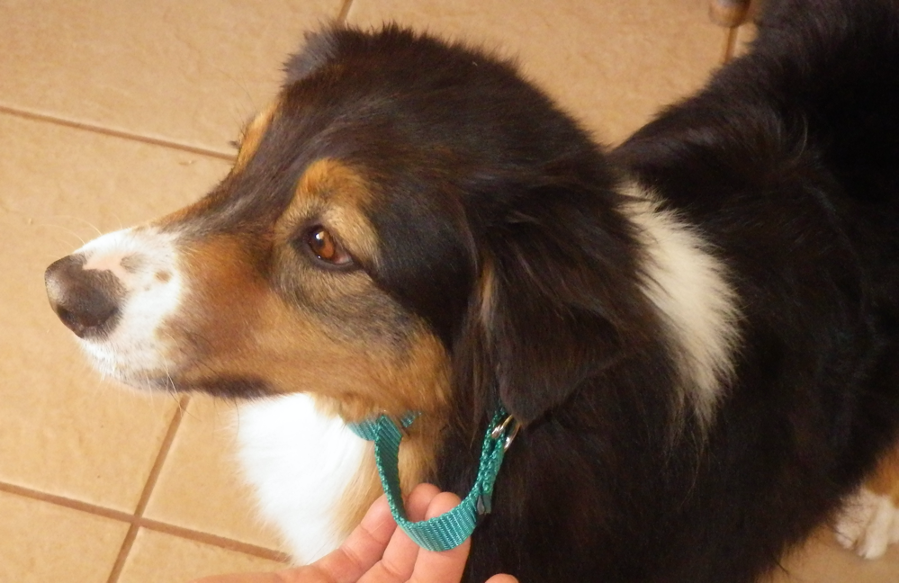
You need to be able to touch every square inch of these pups bodies, from front to back, top to bottom, leaving no square inch unaddressed. but the single most critical piece of the handling is handling the mouth. I literally handle the mouth on these guys a couple hundred times a day. Your fingers should be TOGETHER. Fingers apart invites a bite. Fingers together is like Mom’s mouth. You want to touch firmly, not lightly or teasingly, and NOT back and forth. Stroke firmly from the front of the mouth towards the back of the head.

Martingale holds the head steady while I stroke the muzzle starting in front at the dewlaps and moving back over the top of the head and down the neck.
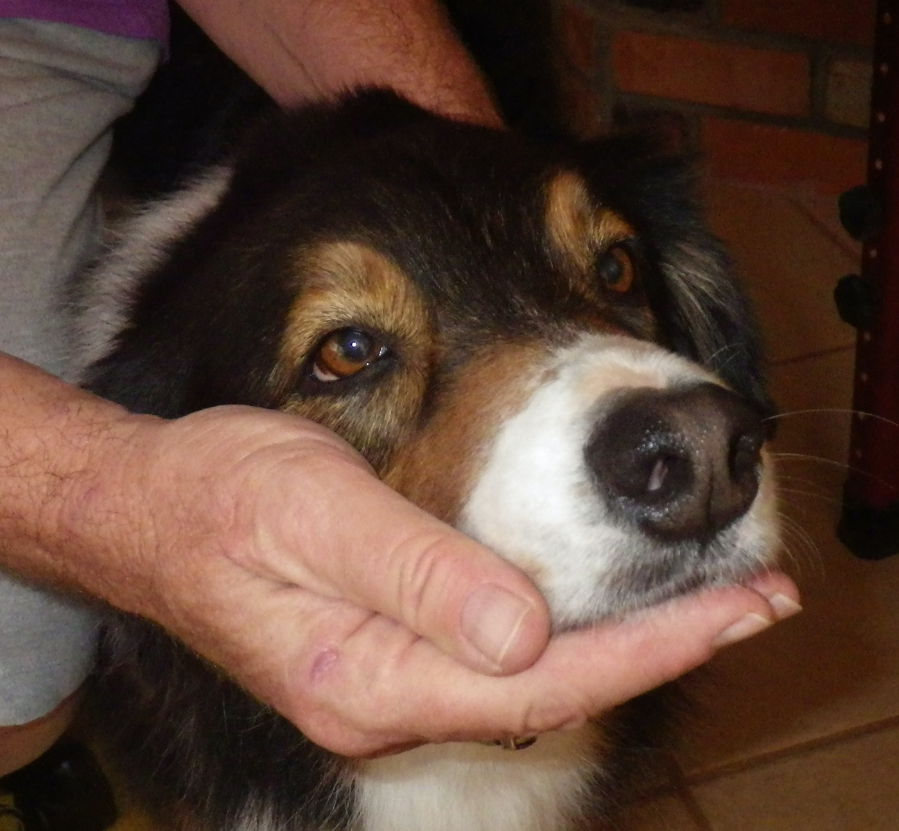
I will warn you that the first few sessions of touching, (and I generally just do this for FIVE minutes) can be incredibly noisy and dramatic. Five week syndrome puppies will shriek at the top of their lungs as if you were killing them with just simple stroking. Really exciting sessions may involve biting, snarling, and even peeing, defecating or blowing their anal glands. Just quietly persist. You must be prepared for disproportionate drama and hold on quietly and firmly as you stroke. Think a momma dog licking a squirming pup, or a human mom holding on to a wet, squirming baby in a tub. Again, these are tiny short sessions, which I typically keep on the clock and quit when there is the tiniest indication of a momentary pause in drama — a breath, a sigh, a slight relaxation.
With extreme 5 week puppies, you may well need to glove up in leather gloves the first few sessions so you can just let them mouth on you until they calm down without worrying about harm or jerking away and interrupting a soft rhythm. Less severe pups can be handled as shown below by simply gently closing the muzzle, as you are touching the dewlaps, cheeks and head.

Pay particular attention to the dewlaps, the sides of the muzzle that hang down over the teeth. Handling those and bringing sensory and proprioceptive awareness to those dewlaps is critical, critical, critical to developmental behavioral stability. I’ve even had really rank substantially older “can’t be touched” dogs gentle up from repeated careful handling of the muzzle and reward for tolerance.
An important clarification. This is NOT DESENSITIZATION techniques per se. We are NOT going to the edge of tolerance and then backing off. That is exactly what NOT to do with these pups, as it merely serves to strengthen the wrong pathways. Instead, we are carefully using FLOODING TO RESET NEUROLOGICAL SENSORS. It is the quiet, persistent touching through the overly low thresholds and the chaos that ensues that resets the thresholds.
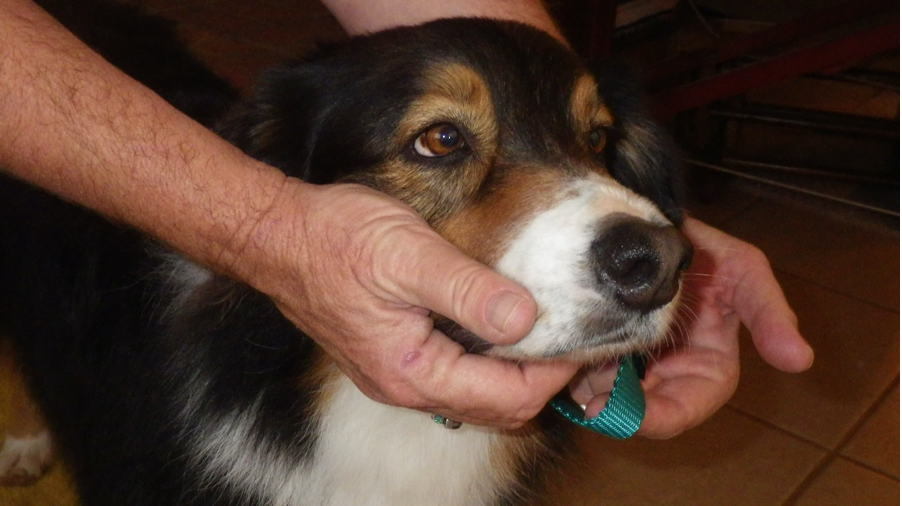
Bringing the martingale forward to steady up the dog while handling the dewlaps.
Reward by pausing your hand briefly when the pup takes a breath, blinks, or calms in any way, shape or form. I also try and use food treats, very tiny pieces, if the pup will take them. They pause the drama, I mark it with a “yes”, and pop a treat in their mouth. Some of them won’t take a treat the first time nor will you get much of a pause, but nearly always there’s some tiny moment in time they stop to suck in a breath, which you can use to mark and reward.
There are critical neurological reasons for persisting with these pups to flooding level. These are NOT neurologically normal pups who just happen to not feel like getting touched. These are pups with an artificially low threshold to touch, who need a serotonin flood to reset the touch barrier threshold. Repeat, THEY NEED THE SEROTONIN FLOOD TO RESET THE TOUCH BARRIER THESHOLD. The less they fuss, the shorter the duration of time you need to touch. The more they fuss, the more their touch threshold needs to be readjusted. Gentle, closed finger stroking mimics mother’s lapping tongue. It’s a natural language for them that they tune in to pretty quickly.
We’ve had a couple of pretty cattle dog pups here at the ranch this last month who came out of a shelter as pups (this e.g., was back in 2009, since repeated a thousand times with other pups). We could never get clear information if they were born in the shelter or brought to the shelter, but both of them had the full panoply of Five Week Puppy Syndrome™ characteristics. Both of them screamed like banshees when we started to handle them. The owners had not been able to touch them all over. Different parts of their body engendered louder drama than others, but mouth was hands down (as is typical) the worse. We’ve been working with them about a month now, and one of the pups is completely soft as butter now, affectionate and eager, touchable everywhere, and starting to put together multiple training concepts in sequence. The other is about halfway through the curve. Happy as a clam to dash in and out of other dogs and people bang into them, receive treats, gallop off, tumble, get up and gallop off again, unhappy to restraint and touching, but allowing, but still very intolerant of close restraint around the face.
Sensory Exposure:
In small increments, using markers (“yes”) and reward, these pups (like all pups, but for these guys critical, critical, critical) need to be exposed to all sorts of sensory stimuli such as lights, sounds, textures, temperatures, smells, and a wide variety of visual landscapes. Bang a pot, have the pup sit, treat reward. Get them in the tub, sit, treat reward, and pop out. Take them in the shower (different feel to the tile), treat, and pop out. Take them out different times of the day, at night, in the car at different times of the day and at night, to different areas of town. Hard surfaces, soft surfaces, grass, sand, rocks, sticks, leaves, snow, ice, (heck you can dump ice cubes in a tub and let them explore), inclined surfaces, asphalt, concrete, linoleum, rugs, manhole covers, metal, wood, are all important to increase their sensory vocabulary. Check out scavenger hunts and socialization lists in good puppy books like The Art of Raising Your Puppy by The Monks of New Skete, or Sarah Wilson’s Smart Puppy.
ADDR Tolerance Training™:
You cannot simply expect these puppies to be tolerant of the normal interactions of a household without explicit training. So one of the most simple and important pieces here is to bump into your puppy. Yup, bump into him. Many Five Week Syndrome™ puppies go ballistic if they get bumped into, so I bump into them, many, many times. Not hard, it’s just a bump. Bump, wait for a non-drama piece of behavior, mark it with a yes and reward. Bump, “oh what a good puppy…sit, yes, …treat”.
When I’m doing tolerance exercises, I almost always have a line on the dog either a short drag line or a long line, so that I can just step on the line, keep the pup with me, and interact with them without them running away. I can keep the energy low key and mark and reward in a timely, soft way. Once the pup is oblivious to being bumped into other than to move out of the way, I poke behind the shoulders and in front of the hind legs – the tickle spots. Again, EASY, it’s just a poke to get them used to having things bump into them. I’ve seen these guys whirl and snap at a branch or a lawn chair that had the audacity to “poke” into them. These guys seriously need to learn how to get a life and not get so excitticated about every little thing. Your job is to help expose them enough so that they’re old hands at life.
My core check list for tolerance training includes: 1) bump; 2) poke; 3) grab a foot, hold, and release; and 4) grab tail, gently, restrain for a few seconds, and release. You’re not torturing the puppy, honestly. Had this pup been in the litter, his siblings would have chewed and pulled on his tail a thousand times before he ever got to you. We’re making a game out of this, not teasing. So, I’m standing on the leash, I poke behind the shoulders, (quick, light, just strong enough so that the pup can feel it), tell the pup, “Ooh, what’s that”, as soon as his head comes around towards you, offer a treat.
I only do this once or twice here and there throughout the day. I never allow a negative reaction to remain. If the pup reacts to a poke or bump, have the pup do something else to divert their attention and allow them to be successful, for e.g., sit or come…mark, reward, release, play for a few minutes, do a tolerance cue again, bump or poke, or restrain, mark and reward. Do NOT do tolerance training over and over again. Unlike our handling work, a little bit of tolerance works goes a long way.
CONCLUSION
Filling in the holes for mother nature is time consuming beyond measure, and a poor substitute for her effortless grace, but by recognizing the developmental issues that can arise from removing a pup from the litter too soon, and combining the ADDR Handling Exercises™, controlled Sensory Exposure and ADDR Tolerance Training™ you might, just might, pull a nice pup’s soul out of the trash and into the land of basic balance.
30-30-30
Copyright 2009 Ozuna
***
Maryna Ozuna
http://www.dog-trainer-arizona.com
http://www.dogbodycare.com
movementmarkers@gmail.com
 tales from the sonora