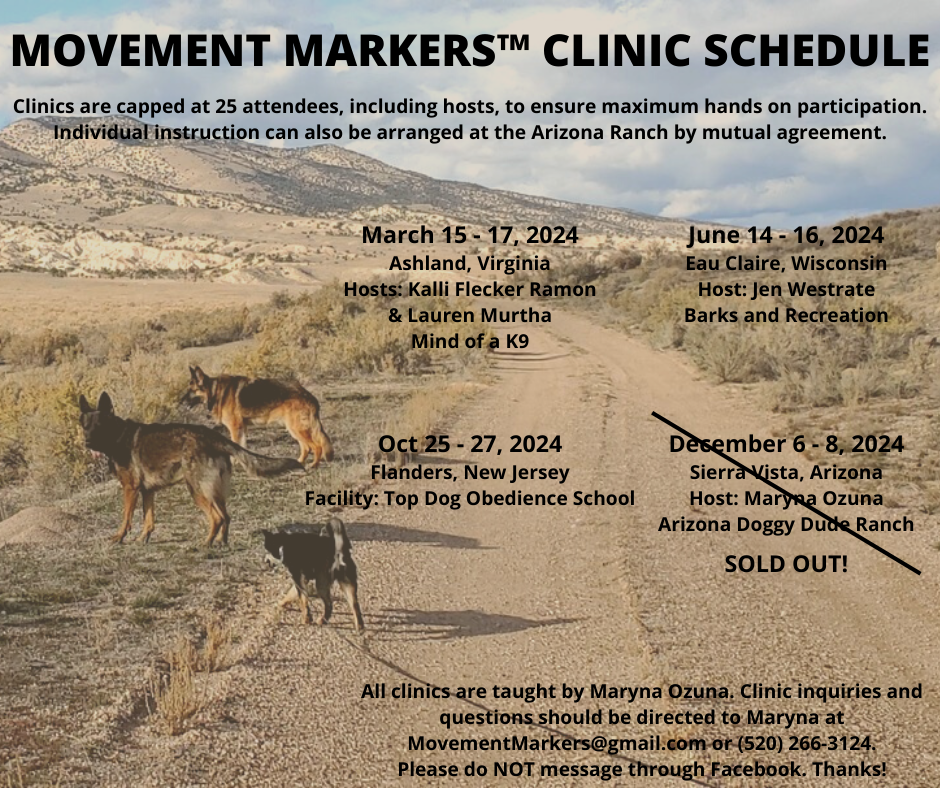
Movement Markers™ National Schedule 2024
Image
The Puzzle of Aggression
Part 2 — Check list 4 yo Weimaraner
Copyright Ozuna 2023
1. Genetic high defense drive. Observed in both parents.
Remedial focus: Drop defense drive, reward focused prey drive. Hand feeding at least half of food daily.
2. Genetic low biddability. Observed during training.
Remedial focus: Hand feeding at least half of food. Increase eye focus, attention, and engagement.
3. Genetic low prey drive and subset genetic low hunt drive.
Remedial focus: Increase food drive, increase ball drive.
4. One trial learner for adrenaline based behaviors. Multiple trial (and slow) learner for cognitive based behaviors.
Remedial focus: Constant calibration of the following: How much information to give. What rate/speed of information flow. What rate of sequencing. Duration of down time between training sessions.
5. Practiced aggression. Endocrine reinforced OCD reactivity behavior.
Remedial focus: Building replacement behaviors. All the standard obedience commands for language stability. Building more balanced metabolics through repetitive rhythmic movement. Building an offleash recall and 2x a day pack walks at a moving trot for a .5 hour. Herbal tincture (Tranquility Blend by Animals Apawthecary).
6. Too high arousal levels. Super high flashpoint, high prey drive when at arousal levels. Goes from 0 to over the top with no middle ground. (Low prey drive when at normal arousal levels.)
Remedial focus: Proprioception, proprioception, proprioception, nutrition (lower carbs, increase quality of absorbable proteins) and herbal tincture.
7. Touch Diva. Intolerant of touch anywhere on her body.
Remedial focus: Dr. Cheese Whiz — truly an unexpected ally. Very fond of her cheese whiz.
8. Low proprioceptive quotient — impacting learning capacity through all six stages of learning: absorb, retain, sequence, generalize, extrapolate and problem solve information.
Remedial focus: Proprioception exercises both through obstacles and out on the trail. Simple movement puzzles (combinations of movements) using obstacles and the trail increasing in complexity. Slowly increasing complexity of sequencing.
9. Nutrition — original food at home decent but ever so slightly high in carbs, low in assimilable animal proteins.
Remedial focus: Dropped carbs, increased assimilable proteins. Observed a reset of arousal levels about every 5 days.
10. Middle to low-ranking beta. Admittedly used as an emotional dumping ground with no boundaries, limitations, clear structure or expectations during core developmental periods resulting in high levels of fear and insecurity in the dog.
Remedial focus: Confidence building — touch, proprioceptive exercises, movement, commands,sequencing, clarity, reward.
***
Maryna Ozuna
http://www.dog-trainer-arizona.com
http://www.dogbodycare.com
movementmarkers@gmail.com
The Puzzle of Aggression
Part 1 — Article
Copyright Ozuna 2022
On the many training groups I monitor, I keep reading questions posed or descriptions of dogs with “aggression” as if aggression were an on/off switch, as if somehow if we just find the right technique, attend the right clinic, watch the right video then we will figure out how to turn “it” off. Yet, aggression, and/or reactivity or behavioral imbalance is always a many splendored thing composed of multiple moving parts. I don’t even think of it like layers because there are so many pieces interacting simultaneously to create instability or a negative response to stimuli.
I thought it might be useful to parse the components of a dog I worked with who presented on my first introduction to her in the dog yard with snarling, charging, serious intent to bite. A 4 yo, spayed (at around 1 yoa) Weimaraner, she had bitten the male owner, and had been so reactive at her last vet visit that no one could get near her, and they had excused her. She pulled out of her flat buckle collar before we could get a martingale on her for safety, and we had to lasso her to get a buckle on martingale on her.
Over the course of time working with her, she calmed down day by day as we put a complete holistic program in place. Continuing evaluation of her in the process and detailed further questioning of the owners revealed the following rough profile of the components of this dog’s presenting instability. This list is by no means exhaustive but gave me a working framework that I could use to shift behavior.
Working Profile:
1. Genetic high defense drive. Turned out that the parents of this litter had also exhibited a high level of reactivity to “stranger danger” and over the top defense drive response to visitors. This is a breed that should have super low defense drive, so already we know the internal components are not lined up the way they should be.
2. Genetic low biddability. Accompanying that was super low pack drive and its working component biddability — the desire to work with a handler. I had to build biddability one piece of food at a time. Fortunately, in this particular case, I was able to build a decent food drive fairly rapidly. It is what saved us.
3. Genetic low prey drive, especially hunt drive aspect. This is supposed to be a bird dog breed which should have a high prey drive and within that hunt drive, but it was rock bottom when we started. Normally, with scrambled drives, we want to extinguish or diminish the inappropriate drive (here defense drive) and strengthen the core genetics that would bring out the best linked genetics in this dog — which would be hunt drive, but she had virtually none for me to strengthen. We had to build that artificially through food drive and then ball work. Building correct drives rebalances the dog from the inside out. There are many linked behaviors that come with this drives that we can harness to use for creating overall balance in the brain and the body.
4. One trial learner/marinator. Another not terribly useful component with this dog was that she was a one trial learner for adrenaline-based behaviors and a slow marinator (have to put away and let them think about it) for cognitive based behaviors. I had to be really careful how much to present, at what rate of learning or sequencing, with lots of down time in between sessions to absorb the slower cognitive pieces I wanted her to acquire. She was really fast to snatch adrenaline-based behaviors (a result of the high defense drive) and super slow to capture cognitive concepts. A common, but difficult little quirk in her learning capacity.
5. Practiced aggression. Along with the genetic high defense drive she had hard wired practiced aggression. She had been allowed to charge the fence at the pool guy, and the lawn guy, and other visitors with increasingly ferocious attitude until she started doing the same behaviors with the male owner when he came home from business trips. Practiced aggression is in many ways like an endocrine reinforced ocd behavior. There is also a patterned endocrine response that kicks in when dogs send themselves into arousal. She was 100% not allowed to practice any aggression behaviors of any kind whatsoever, we built and rebuilt opposing go to behaviors, and I used an herbal tincture Tranquility Blend by Animals Apawthecary, just one dropperful in her food at night for a week to help mute the overworked arousal response, and allow her a deeper sleep.
6. Arousal levels too high. When we started her adrenaline/arousal flash point was very very high. She was that person at a party who was wired just a little too tight. The slightest thing would set her off into: reaction, confusion, panic, shutdown — it ran the gamut of responses but all were arousal-based behaviors. Bumping into her was like a major calamity. Moving too quickly caused her eyes to dilate almost out of her head. She was locked and loaded all the time in the beginning. Work, food (a minor detail in her case, see below, but still significant), herbs, and a lot of getting out and moving over terrain to build proprioception and hunt/prey drive helped shift that down so she could relax and be just a dog. About every 5 days we could see a major downshift in the arousal/adrenaline load. It was fascinating to watch the transition occurring.
7. Touch diva. When we started, she could not be touched anywhere. She totally and completely dictated what, where, when, and how she could be touched — or not. Part of that was genetic, part of that was practiced arousal which makes all creatures, 2 legged or 4 hypersensitive to touch, and part of that was a lack of foundational training in touch tolerance. The problem with touch defensiveness is it so rapidly becomes a self-fulfilling negative feedback loop. The more resistant she is to basic touch and handling, the more people are going to react to her, and the more she is going to react to them. In her case, it had escalated to levels where she could no longer even be allowed in her veterinary practice and my clients had great relationships with their vets, but her behavior and resistance to touch by anyone other than the one owner was just putting her beyond the pale. I only wish that I could tell you that my brilliant touch techniques brought her around. Hah. I have to laugh ‘cus yeah, I bring a lot of touch techniques to the equation, but it was really Dr. Cheese Whiz that did the work. This girl was a fool for cheese whiz. After a while she would just about stand on her head for a hit of cheese whiz. Another lucky turn of the dice.
8. Low proprioceptive quotient. Like nearly all reactive dogs, in her case part of her being a touch diva, not being handled enough, and not having an off-leash recall so she could move over terrain, she had a super low proprioceptive awareness of where her body was in space at any time. This greatly diminished her learning capacity in the beginning and accentuated the whole profile. As proprioception came up, reactivity came down, and learning capacity came up.
9. Nutrition. Last, in her particular case, nutrition was not that big of a kicker, but was surprisingly more than I expected. The food she was on was a really good food, but it did have a higher carbohydrate load than I would prefer to feed, and she was ever so slightly plump when we started. Really just slightly — like a low to mid 6 on the weight scale where I wanted to see her at a fit mid 5, right at that perfect balance point. Where food has been a huge component of endocrine imbalance, unstable behaviors, I typically see a very rapid shift in behavior within 72 hours of a food switch, that then also typically resets even more every 3 days or so until it rapidly hits a whole different plateau and levels out at about day 10. In her case, the change was much slower, a very small incremental reset about every five days, but over the course of weeks, it became patently apparent. Obviously, her whole body reset was the product of many factors, but the impact of the food and the steady increase in food drive and hunt drive and biddability were apparent and made the food shift significant.
Hopefully parsing out this kind of analysis will allow trainers to reach a little deeper for the component pieces of unstable/reactive/ or aggressive behavior.
30 -30-30
***
Maryna Ozuna
http://www.dog-trainer-arizona.com
http://www.dogbodycare.com
movementmarkers@gmail.com
Movement Markers™
What is That?
Copyright 2020 Ozuna
Movement Markers™are a vast array of postural, conformational and movement pieces of information and concepts that provide indicia of a dog’s physical and behavioral health and attitude, reactivity, drives and overall mental and temperamental balance. The following components and their potential behavioral implications are just a few of the Movement Markers™we look at.
— Symmetry and parity side to side
What obstacles are there to learning and retaining learning?
— Conjunctive and dysjunctive aspects to the body
What mixed signals are being sent to other dogs?
— Point of balance
Where are the balance points of arousal, impulsion, collection?
— Integration of body front to back
Literally is the brain connected to the body?
— Whether the movement is “through” from front to back
How quickly and well will new information be integrated?
— The flight pattern of the legs
Is the dog in balance or shifted towards physical instability and perhaps behavioral instability?
— The integrity of the foot falls
How much tension is there in the body? How much stability or instability?
— The flexion or lack thereof in the body
What ability does the dog have to handle pressure or integrate stimuli?
— Areas of stiffness in the body
How much resistance to learning will there be?
— Areas of dysfunction in the body
What impediments to learning, physical or behavioral stability are there?
— Angulation and rotation of the shoulders
How much stress is the dog exhibiting?
— Lift and fall of the chest
Where is the dog on an aggression scale from 1 to 10?
— Suppleness or lack thereof in the hindquarters
Where is the dog on an aggression scale from 1 to 10?
— Integration of the forequarters
Is impulsion grounded in stability?
— Smoothness or lack thereof in the coupling between forequarters, neck, and head
How easily can this dog come back in balance after stimuli?
— Proportions of topline to underline
What is the natal balance point and natal temperament of the dog?
— Proportions of topline to leg length
How much has that natal balance been supported or distorted by nutrition, development, and training or lack thereof?
These are just some of the pieces of the Movement Markers™puzzle we look at, and all of these pieces can act together or separately to impact the behavioral profile.
***
Maryna Ozuna
http://www.dog-trainer-arizona.com
http://www.dogbodycare.com
movementmarkers@gmail.com
For nearly 40 years now, since my Dad first made soccer players dribble tennis balls and move over grids, I have been experimenting with the impact of exercises promoting the development of proprioception in humans, horses, and dogs. In the past 20 years, when I have been focused more in the dog world, I have seen proprioception work help reorganize the brains of hundreds of dogs: increasing and maximizing learning capacity, slowing and focusing “squirrel” brain, softening reactivity, increasing visual focus, increasing handler connection, increasing confidence, decreasing stress, increasing engagement, and just generally helping build a more balanced brain and balanced attitude. Over the years, we have honed and honed the components of what I now refer to as Movement Markers™ High Density Low Impact Proprioception Courses (HDLIP Courses) to maximize impact in a short, discrete exercise. (See below at the end for the essential components as we know them at this time.)
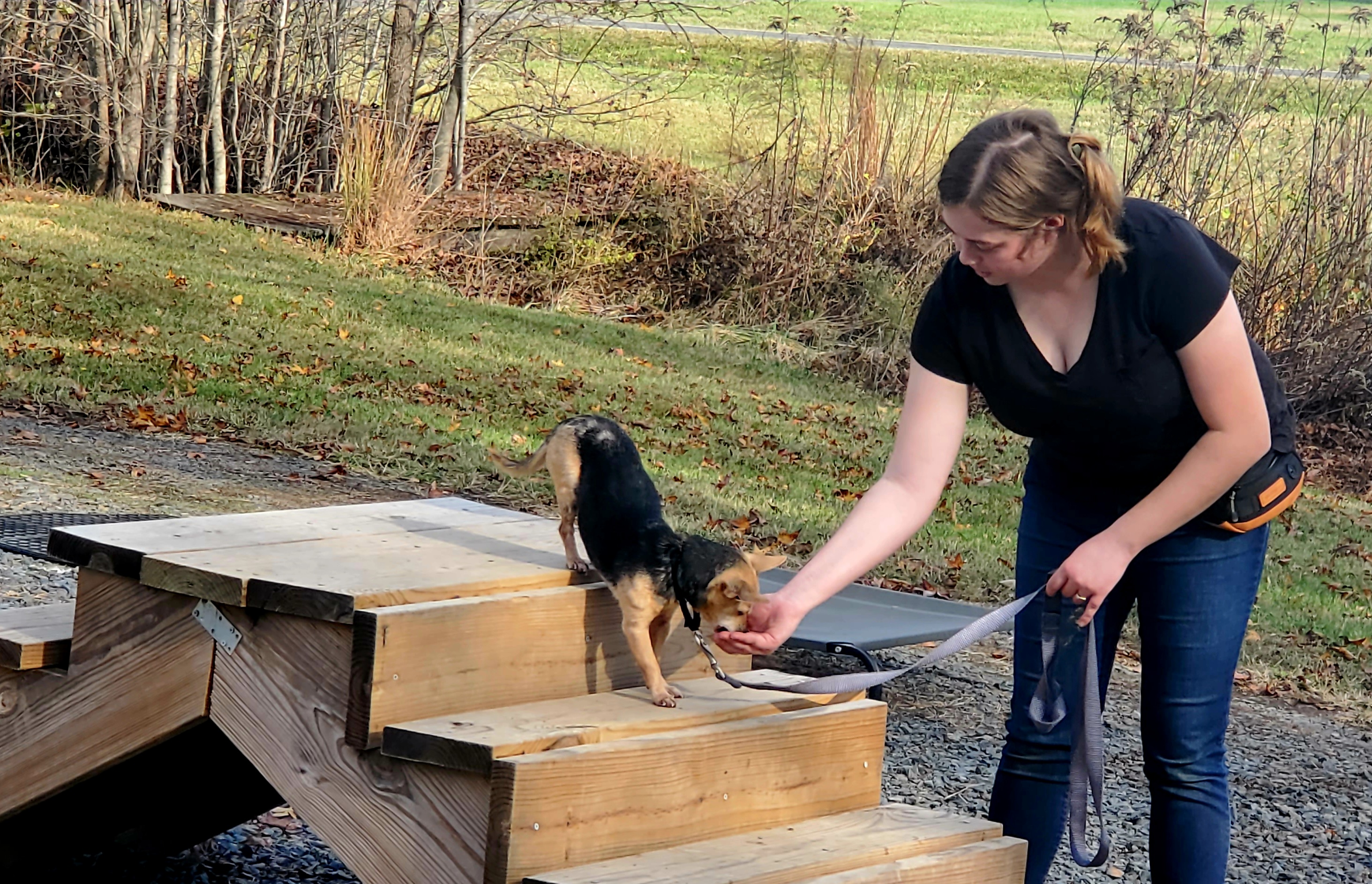
While we have always had a senior dog or two in the mix during these exercises at clinics, with them I was more focused on preserving certain levels of physicality. I was not particularly focused on the potential mental health perks for our elder dogs. While I had seen many senior dogs clearly enjoy the courses, I had not observed clear trends to the behaviors. However, we also did not have the courses and protocols developed to the degree we have now, which I think is a critical difference. What I had the great privilege and pleasure of observing and learning at a recent clinic in Charlotte was that our HDLIP courses had the capacity to turn on a Senior dog brain to the point that we were all dumbfounded watching it happen. Yes, I personally have done innumerable enrichment protocols with my elders, but I can honestly say, I have never seen anything turn on senior dogs like a light switch within moments, the way our course did that weekend. And it wasn’t just me observing this. Everyone was calling out and pointing and watching our elders sparkle. The eyes just lit up. Chests came up. Tails came up. Stiff dogs started prancing. Each and every elder from four different households had the same response. So exciting to see.

Our work with the dogs that weekend deeply enhanced my perception of the potential impact of High Density Low Impact Proprioceptive Courses on not just the physicality of our senior dogs, but their mental health as well. (As always with all dogs but especially with senior dogs, within appropriate medical limits, of course.)

Protocol: Here are the critical components of the MM™ High Density Low Impact Proprioceptive Courses (HDLIP courses) as we know them at this time for whatever age dog. This work is continually evolving so stay tuned!!!
1. Course work should be done with the dog in a properly fitting martingale (so it just slips over the cheekbones or on a snap-around has only 2 fingers of slack) narrow as possible, with the martingale spun so the leash is coming off the top between the shoulder blades. This supports the head and neck and forequarters in a very particular way. Working the dog in a slip lead, flat buckle collar or other equipment, all of which by their physical components, can trigger oppositional reflex does NOT create the same mental impact and I ONLY use martingales for this exercise. (I don’t make the rules, I am merely reporting what we have seen after thousands of reps of trial and error.)
2. These courses are done in an exaggerated slow motion, ONE STEP AT A TIME to individuate the legs and maximize proprioceptive impact to the brain. THIS IS ESSENTIAL. Nothing happens without this exaggerated slow motion.
3. 12 obstacles seems to be the magic number of obstacles, which we sometimes set up as two parallel lines about 6′ apart of obstacles, or in a curving arc.
4. The sturdier the obstacles the better and deeper the learning. Plastic obstacles work to a certain extent but we do not see quite the depth of response.
5. Obstacles should be fairly close together, just a couple of paces apart again for maximum impact. Urban agility courses serve a different purpose and are typically laid out with the obstacles farther apart. Here we are trying to create a very specific brain impact.
6. Varying components of up, down, over and through with different textures seems to be key as well.
7. To the extent possible, the handler needs to not solve the puzzles for the dog but LET THEIR BRAIN work. Leash should be used to help balance the dog, where necessary, but as little as possible, and as little as possible between obstacles, letting body language and a little bit of food luring, if necessary, do the work. Do NOT pull the dog from obstacle to obstacle with a tight leash.
Have fun with all the dogs, but for a special gift put back a bit of sparkle in a senior dog’s eyes.
***
Maryna Ozuna
http://www.dog-trainer-arizona.com
http://www.dogbodycare.com
movementmarkers@gmail.com
Puppies and small dogs are still quadripeds and should not be picked up like a bipedal human baby.

Nor should they be cradled like a human baby. Again, their spines and pelvis were not meant to be bent in this way.

Instead, they should be picked up with their bodies level, horizontal, in plane with the ground, fingers supporting hooked under the front of the sternum, forearm reaching under from the far side, cradling the pup in like a football.
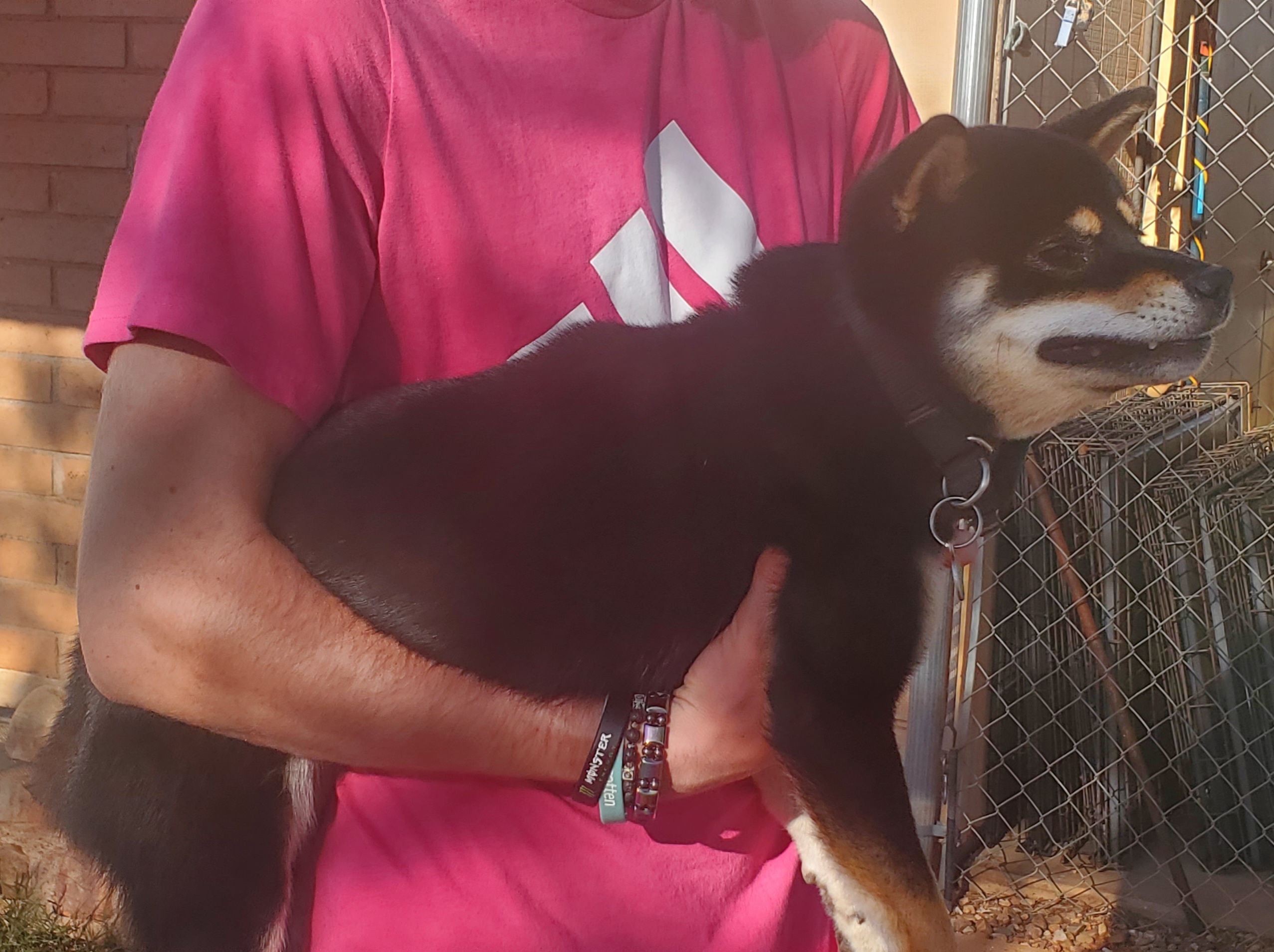
No shibas were harmed in the taking of these pictures….wink.
Maryna Ozuna
movementmarkers@gmail.com
520 266 3124
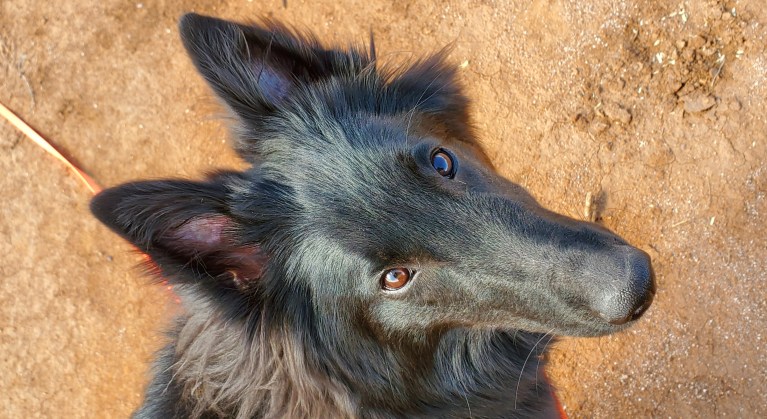
Reward is one of the most complicated concepts in dog training. For me, mastering its nuances is both the art and the craft of what we do as trainers. Yet, too often the discussion on a million internet posts is phrased as “to reward or not to reward”, as if that is the sum total of the dialogue, and the only relevant question. Yet, whether to reward or not to reward when shaping a behavior is only one of a 1000 questions to be asked. Rather the discussion needs to be if, and if so, what are we rewarding, how, when, why, where and in what fashion, what context, and with whom are we working and what are their likes/dislikes/preferences, strengths/weaknesses, in short, an endless kaleidoscope of details that make all the difference between good training and mediocre or bad training. This article is a brief, by no means comprehensive, look at some of the considerations that come into the training equation with respect to the question of reward.
Behavior:
Is the desired behavior, at this moment in time, something that will shape easier with reward or without? Do you want the dog to do something or to NOT do something? If a NOT do something, what do you want the dog to do instead? If it’s a DO something, what stage of learning are you at: showing, teaching, reinforcing, or proofing? Are you aware of the difference between those stages of learning? Depending on the stage of learning or rehab, or end training goal, what precisely am I rewarding? Am I rewarding drive? Effort/try? Position? Execution? Steps towards execution? Polished execution? Execution under distraction? Polished execution under distraction? Focus? Changes in behavior — both to do or not to do something? How big of a change in behavior or how small? The exercise? Pieces of the exercise? Just showing up?? As a colleague once said to me, “What are you trying to teach in this moment?” All of these things (and many others) can be separate and distinct rewardable moments. What are you trying to teach IN THIS MOMENT IN TIME, not an hour from now, not tomorrow, but where is the dog at vis a vis your training objective right now. Do you need to break something into smaller pieces, link pieces together, start a new piece, review an old piece? What are you doing? What is your teaching plan. And since training is the ultimate life humbling exercise, how can you shift to reframe or refocus if training is not proceeding according to plan.
Arousal levels:
Do you want arousal levels up or down? Is this a rehab or train of an already over aroused, reactive or aggressive dog, or at the other end of the spectrum, a timid or fearful, who ironically will be equally dysfunctionally flooded with adrenalin. Rewards may need to be low key, touch or voice only, where pups or dogs are already overexcited or aroused. Many, even low to mid drive puppies and dogs, come into training anymore already addicted to their own adrenalin. Adding fuel to the fire does not give you a brain to train to. Or is this a competition dog that we are building, building, building focus and engagement for increasingly complex tasks, and longer durations of concentration. Again, at the other end of the spectrum is this a competition dog who is getting too aroused, and easily distracted and unfocused. How, when, what, and where we deliver reward may all need to be tweaked. Arousal is not in and of itself a bad thing, it depends on the context, and what the dog’s response to arousal is. If the response is snappy, nippy or reactive…not so great, and reward may need to be modulated or timing very carefully orchestrated to reward calm focus not the moments where the dog is losing its mind. If the response is buoyant, focused performance, well then mazeltov, reward is on point.
The Participant — the Dog:
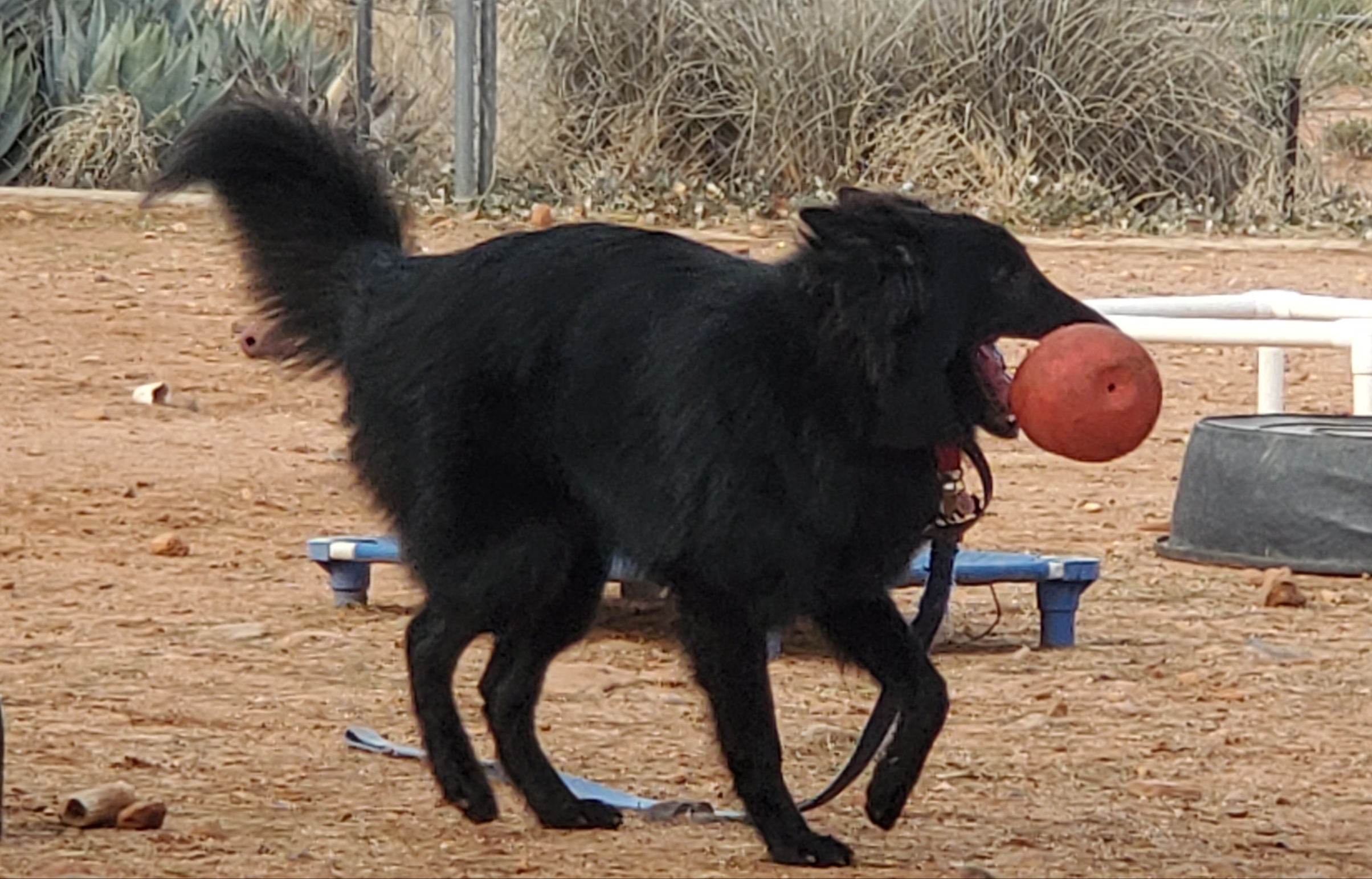
What does the dog you are working with bring to the equation? Reward is as individual as the dogs that come through our doors. I currently have three personal dogs. Rajah, the old boy shepherd, wants his reward as food, food, food, and delivered in a static (non-moving) fashion with quiet hands. The higher the food value, the happier he is. Steak would be his life goal, but chicken and cheese would not be amiss. That they do not appear on any regular basis, he considers my failing. Lily, the opinionated alpha elder Shiba, wants her reward food based but tossed away from her in active prey mode. Hard, crunchy food doesn’t work for her, soft and fast munch builds her drive. Whatever position/task we were training when I was competing with her, I had to find a way to deliver reward in an active fashion, so that meant choosing certain rewards that both met her nutritional needs, were soft, but could be thrown and wouldn’t fall apart, and it meant not training on dirt, which at a grassless dirt/clay/sand ranch was challenging. Carport were us. Kerrtu, my 2.5 yo shepherd, on the other hand outgrew food early on, and only wants an active reward — tug or ball, and loves it the absolute best, when we are doing so in a dynamic fashion in two senses of the word. She loves it best when the ball/stick/pinecone is thrown, but even better if we incorporate the throwing/reward while moving all across the ranch, not just hanging out in one place. She wants double dynamic reward, and thrives on that level of complexity. For her, we work out on the trail, in and out of formal commands and positional work. Both the other two would shut down at that level of dynamic reward. They do not have the drive to sustain work for that kind of reward.
Typically, with my pups in training, I am hand feeding a portion of their food, a core resource, as opposed to feeding a treat, something additional, as I want an extremely high level of low stress focus, and low gut impact. Using food, a core resource, gets me a higher level of focus, and nearly all pups within about 48 hours will click in to the food game which we will do in various contexts building positional memory: come to a hand target, touch, sit, down, place, and eye contact. With them, I am delivering the food in a quiet, fixed, cupped hand NOT in my fingertips because I want them taking food with their lips, not with their teeth, as 9/10 times anymore, I am also building bite inhibition with mouthy youngsters. Using the cup of my hand and holding that steady also simulates the rooting reflex, so we are accessing core reflexes as well, giving me an extra deep neurological bang for my training buck.
Not all pups are food or toy driven. Touch is another core source of reward. I am working with a young Belgian shepherd right now, who gets too nervous and overstimulated at times to take food. Ironically, as he was resistant to touch at first, he now comes to my hand for stroking even if he doesn’t want food, like a cat arching it’s back for pets. He comes and shoves his head under my hand, and since coming is what I have asked him for, he gets his pets. He is touched though in a very specific way to increase his proprioceptive (total body) awareness. Again, we are using core neurological processes to aid development and learning. I use a slightly cupped hand, closed (fingers touching) fingers, firm one-way stroking from front to back, and top to bottom. Scary for him at first, now touching is a reward.
If I am dealing with a dog who too easily goes into arousal, whether a fully reactive dog or just a pup who can’t process too much adrenalin then my “reward” needs to be tempered accordingly. If we have a super mouthy or harder edged bitey pup/dog, then the last thing I probably want to do, at least in the beginning, is use food, and even touch may be too much, and just elicit jumpy, erratic behavior. I’d probably start with just low tone voice praise and evaluate the dog’s arousal balance point over time. What reward is too much, what is not enough, what is just right in the moment, is the continuing quest of the trainer. And just when we get a glimmer of rhythm with a dog, all of those considerations will change with the dog’s development, and sometimes from morning to afternoon.
Style and context of reward varies immensely and the style, context, and needs of the dog you are working with vary immensely.

The Mechanics of Reward:
Books, videos, lecture series, workshops, careers have been developed on the subject of the mechanics of reward. I just want to raise a few points for the purpose of reframing and deepening the dialogue. The infinite intricacy of the mechanics of rewards — what, where delivered, how delivered, when delivered — all of those will depend on that initial analysis of WHAT it is we are trying to shape and thus what it is we want to reward, coupled with insight, knowledge and awareness of the dog with whom we are working. Added to which, just to make this more difficult, task, context, dog analysis, and reward are exceptionally fluid. We may reward different components of the exercise in very different ways, during the course of a single practice session, let alone from session to session.
Mechanics: Timing
The timing of reward is an intricate dance whether doing behavioral rehab or command based training. For example, reward in my world, if working on command based behaviors, is coordinated with a careful rhythm of words using a marker system: 1) name, 2) command, 3) marker — “yes”, “good”, or “no” depending on stage of learning and 4) reward or praise language. Marker timing is a four-part rhythm, not always easy to capture, but when you do it is like a waltz with our dogs. And yes, the better you get, and the higher the levels of tasks you are training, or the longer the duration of focus you are asking for, the trickier it gets. I can remember watching an instructor coach one of the members of our Schutzhund (IPG) club on the timing of the release of a bumper reward. You could totally see the dog flatten slightly or motivate depending on split second differences in timing of the release of the reward. Fascinating. Especially when I see so much focus on changing the dogs in endless internet videos with bad timing, rather than a mutual review including changing ourselves.
Reward for behavioral reshaping is the most nuanced and will depend totally on assessing microshifts in behavior in the direction of the desired balanced behavior I am shooting for. That is a topic for another day.
Another component of timing is when and how are you delivering your reward vis a vis the concept you are trying to teach? Is the correlation strong enough for the task you are teaching? Are you constructively building the desired behavior or is the behavior flat lined because the reward timing is off for that dog, that concept, in that moment? Working with another experienced person or coach can really help hone your timing. Timing is a crucial skill to develop as its use or misuse can radically affect behavioral aspect, drive levels and task outcome.
Mechanics: Place of reward
Another piece of the mechanics of reward is the whole concept of place of reward, and its nemesis — consistency. I see innumerable videos on the internet where the reward is delivered in a variety of places throughout the course of a short video in relation to one specific behavior or task with concomitant varying results. Yes, our dogs can be moving targets, but we can still strive for consistency of place of reward to facilitate cleaner learning.
There is a vast variance of opinions on “place of reward” depending on what skill is being taught. Left hand/right hand, fingers tucked back, fingers level, fingers cupped/toy hidden, toy out, there are innumerable details that vary with the task taught and the stage of training. Some skills sets do not require as consistent a place of reward as others. The specifics of place of reward depending on what skill set is being taught is again a whole other article. My point here is be thoughtful about what position you want your dog to be in for a task and reward accordingly. Think about it, film it, review it, change it, and then once tweaked, push yourself for consistency, before you push your dog for consistency. However you are going to define place of reward for that skill set, you need to be consistent in delivery.
Being consistent with place of reward does not contradict the need that may occur to vary style or type of reward during a session. Each of those would also have their best place of reward depending on what is being taught. In addition, place of reward usually evolves as a task is taught. Knowing how and when to vary place of reward is an art form.
Evolution of reward:
As training progresses, reward needs to remain fluid and changeable in many different aspects. Reward is never static if training is progressing how it should. For e.g., when I am first starting a very young puppy, I may be rewarding using a treat/food lure like a magnet, and be rewarding 100% of the time for a particular shaped behavior. If I am using food up over the head of a pup to sit, the pup sits, and food comes directly from the visually close lure position to the mouth. Then I may transition to rewarding after execution and a marker (a verbal marker “yes” or a clicker). Food now is not over the nose of the pup, I simply say the command, mark when executed, then deliver the food. Then, I might transition to rewarding a sequence of behaviors vs. one isolated behavior. For e.g., now I want my pup to sit and stay. He has captured the sit idea, and now I am adding a second concept — sit and hold the sit until I release you. The timing and place of my reward will now shift from the quick reward for the sit to reward on release from the sit. So reward is subject to development along with the development of the dog, physically and mentally.
At some point in time, once I am teaching sequences of behaviors, I am probably going to introduce variable reward, not rewarding 100% of the time to build curiosity and what we call drive to problem solve and get the reward. To isolate one factor, whether or when I switch to variable reward might depend on the status of the dog. I might have a dog who is smart and executes the sequence really well, but is behaviorally insecure and might need way more time at 100% reward. Or I may have a super smart dog who rapidly gets bored with 100% reward. Now we are getting into the infinite nuances of reward and shaping behaviors. But these are all considerations to be brought to bear to the training equation. What the reward schedule is for any given dog or task will vary.
Reward: It is a many splendored and every so complicated thing, and worthy of far more of our attention as canine professionals than a cursory emotional stance of whether you reward or not.
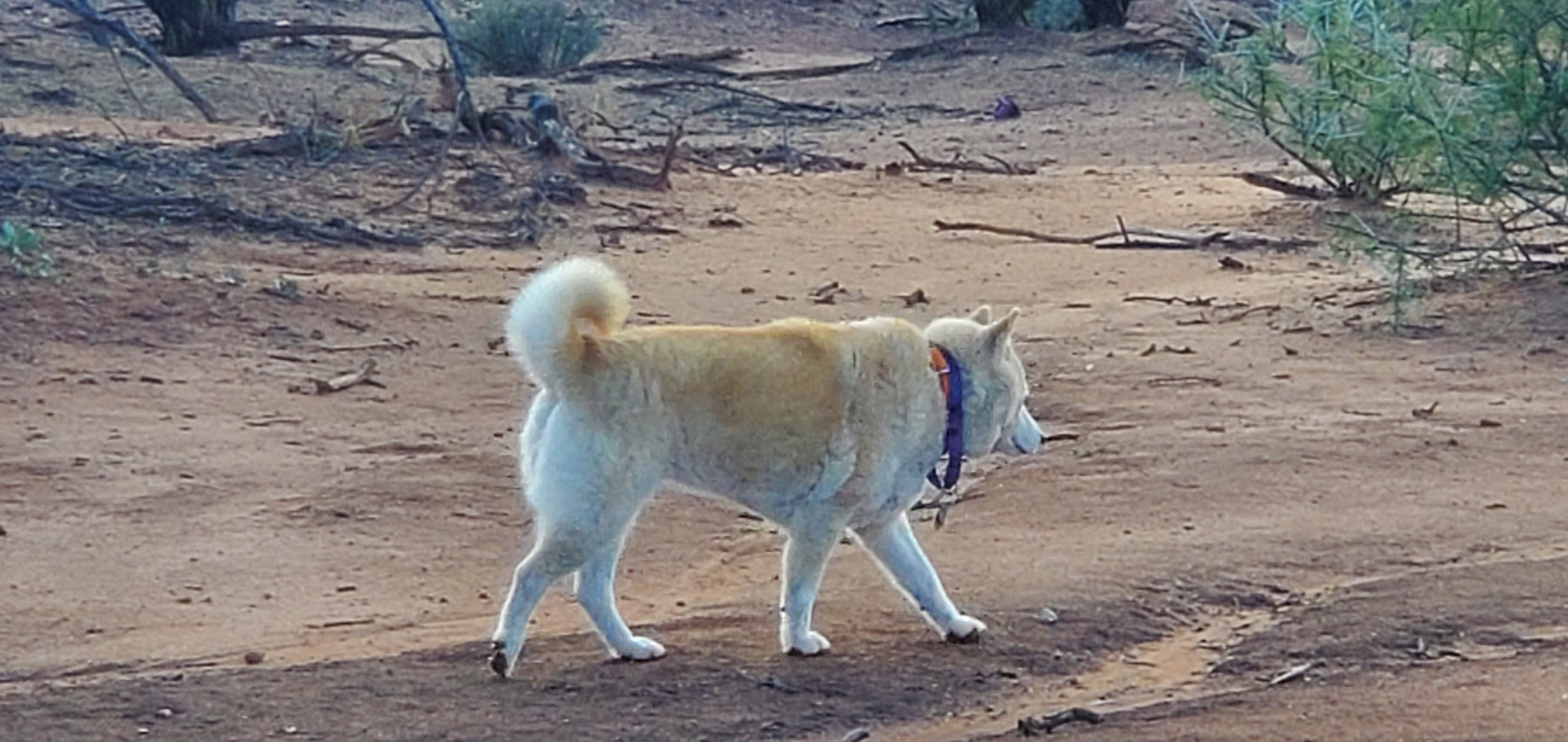
Where did the concepts, exercises and techniques behind the Movement Markers™ Clinics come from and why are these concepts remotely relevant to dog trainers, or dog owners, who have enough on their plates just dealing with the challenges of building solid behaviors and preventing or eliminating chaos in modern dogs.
When I began training dogs professionally, many years ago now, I brought with me a background in human and horse sports, as well as many hours of actual hands on bodywork sessions on humans, horses, and dogs. We all look at the world through the blinders of the tools we bring to the equation, and my tool was movement, and movement analysis.
As a result, I was one of the first in this modern era (these concepts have been around for forever) to talk about the many ways in which proprioception (simplified — body awareness and coordination) or lack of proprioception in modern dogs was affecting their overall physical and mental balance and the training equation. When I began teaching these concepts in clinics, the only other person really writing much about this in dogs was Suzanne Clothier, and the bunch of crazies who were starting this sport called agility, who were more focused on giving modern suburban dogs something to do with their brains than they were about the scientific underpinnings of how movement affected learning. My focus on movement and proprioception led to clinic exercises, articles, the development of concepts like Five Week Puppy Syndrome, puppy enrichment development, hands on techniques specifically for the canine, movement warning flags to subclinical gait issues that we needed to take into account during training, recognizing gait issues that needed to be evaluated by our veterinary colleagues, building partnerships in the veterinary community and daily discussions about all these issues on professional email lists before the advent of social media.
Fast forward to the present, when I am being flooded on a daily basis with pix and video from colleagues around the country checking in to ask if there is “anything going on with this dog” that will affect their ability to learn. Just yesterday alone, I looked at:
We are not veterinarians, thanks be to God. Nor do I have any pretensions or desire to be one. But animal husbandry and basic knowledge of movement falls squarely in our wheel house. We need to know when there is an issue that needs to be referred over to our veterinary colleagues, we need to document for them what we are seeing, and we need to know when there are issues that are going to affect our training strategies, sequences, tool choices and timing.
I am seeing a vast variety of circumstances that squarely affect learning readiness, learning capacity, and behavioral profiles of the dogs sent to us for training. These things directly impact the dog’s ability to benefit from our training efforts and constitute substantial impediments to learning that must be taken into account if we are to achieve results for the dogs and their owners. Some of the most common categories we are seeing for which we have developed protocol include:
Normal, healthy bone development in living creatures requires healthy, progressive stressing, i.e. movement. Dogs are genetically programmed to move, and that genetic code requires certain actions to be fulfilled during development of their bone structure, or it does not develop correctly. Puppies need to run and play and be taken for long walks, long being relative to a puppy. The training trail here on soft ground is a half mile trail and the youngsters do that 2 to 3 x a day when they are here for training.
In response to these floodgates, I developed Movement Markers™ Clinics to help my colleagues
— be able to identify what normal movement and structure in a canine looks like, feels like, sounds like,
— be able to identify when is there a deviation from normal movement that constitutes a problem that may act as an impediment to learning,
— learn how to use a variety of visual assessment protocols to identify gait abnormalities,
— know when to refer those out (always if any question whatsoever),
— how to help that pup/dog and owner when it comes back into our wheelhouse with appropriate training and pre-training strategies, tool selection, tool placement, proprioceptive exercises, hands on sports therapy assessment tools, and hands on bodywork tools for the enhancement of physical integrity for the dog.
There are many pieces of the dog training puzzle. Hopefully, these clinics can add necessary and useful information to anyone interested in maximizing learning and maintaining the best physical integrity in our own and our clients’ dogs.
Copyright all photos and text S.A. Ozuna 2015
1.

Walking the bones of the earth,
seeing the accretions of time,
glimpses of hidden truths,
half truths, new truths,
a palimpsest of history.
When we look at man,
what do we see?
Do we see the eye of the soul,
or merely the accretions of the years,
a contextual crust of many layers.
2.

We are born naked,
and immediately begin
the accumulation of sedimentary debris.
Family,
geography,
history,
religion,
school,
work,
experiences,
seasons,
smells,
memories,
the topological markers
of our souls.
3.
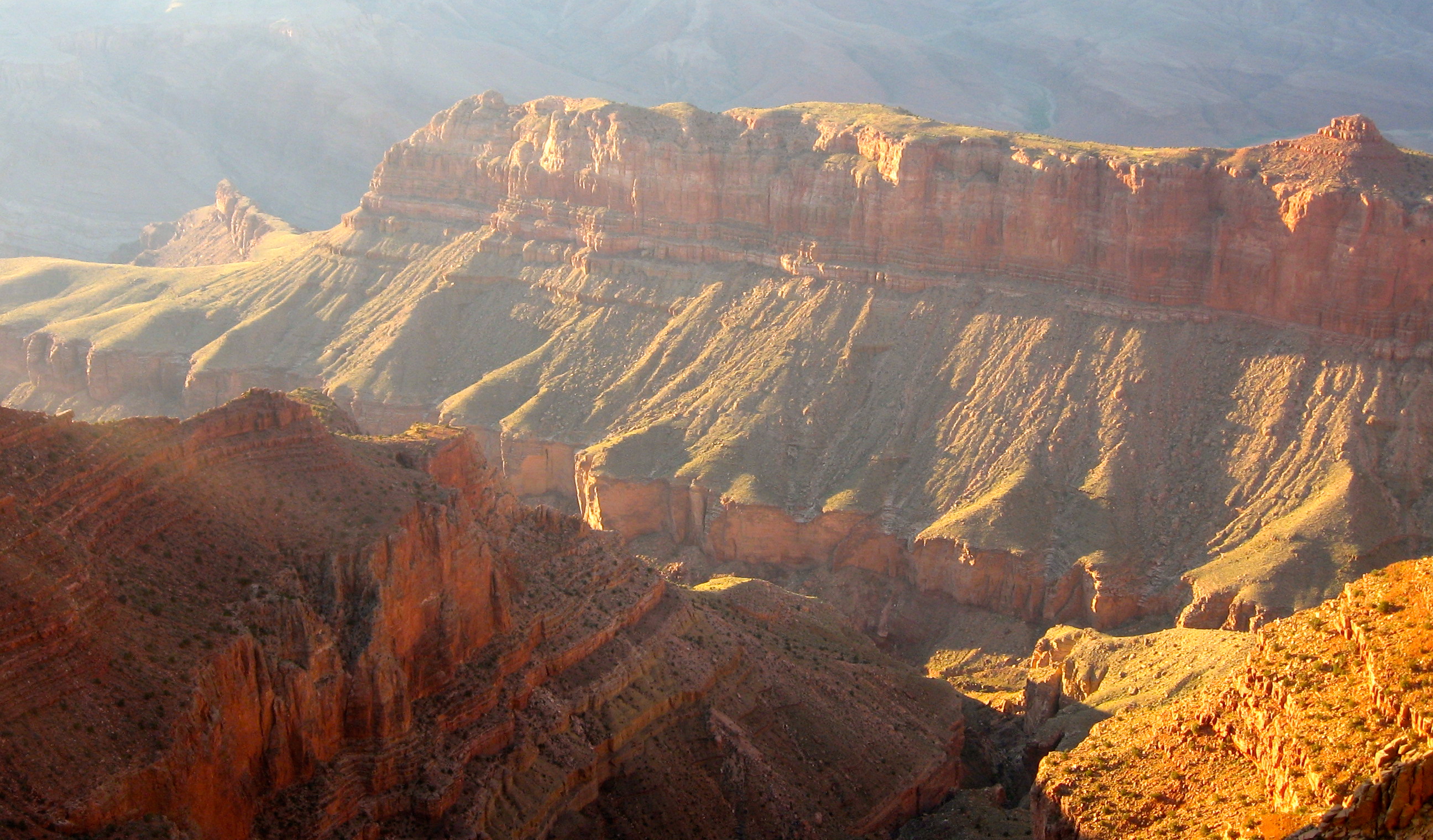
Like minerals on the wall of a cliff,
our accumulations color us,
create the texture of our lives.
We are both enriched by their content,
and separated by the walls they build.
Looking out and looking in,
the world is inevitably distorted
by the kaleidoscope prism
of our accretions.
We see out dimly through our layers,
and the world, looking back, sees
nothing but crust.
4.
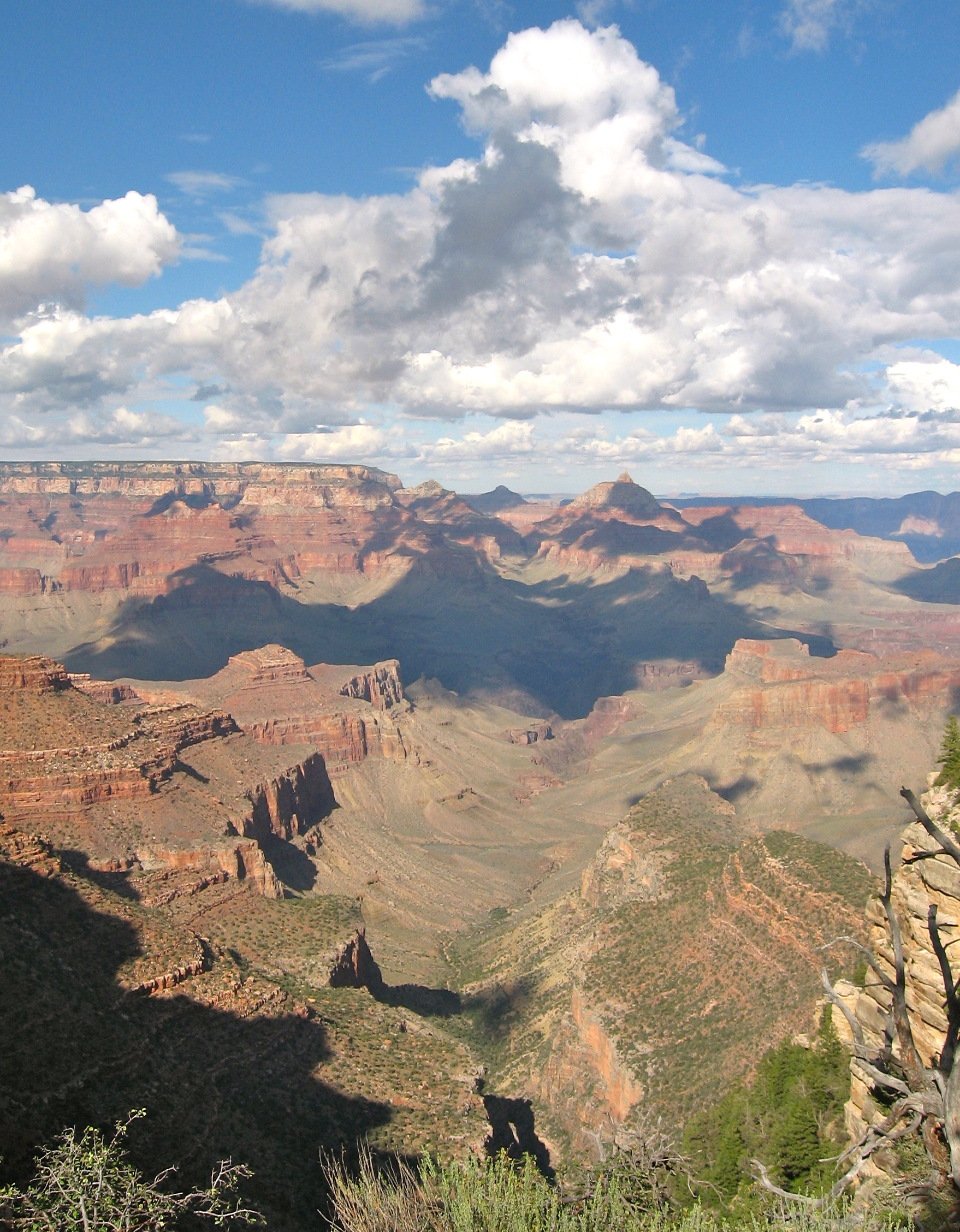
We need to go walkabout
through the layers of the earth,
the layers of each other,
We need to steal from the great lions,
see with cat’s eyes,
piercing through layers
to flesh and bone.
We need to wade through family,
geography, history, religion,
school, work, experiences,
seasons, smells, and memories,
to the eye of the soul,
touch naked hearts.
Earthquakes will happen.
The earth will cleave in two,
shattered by compassion,
riven by history.
5.
 5.
5.
At night, we watch TV,
and weep tears of the moon,
at the images of drowning babies,
while in the morning we reiterate
there is no room at the inn.
Six million lives lost,
their voices echoing on the wind,
Surely we can find room,
there are ghosts holding place markers.
My heart seen from space
would have ley lines of sorrow
for my beloved earth,
her broken creatures,
and wounded mantle.
6.
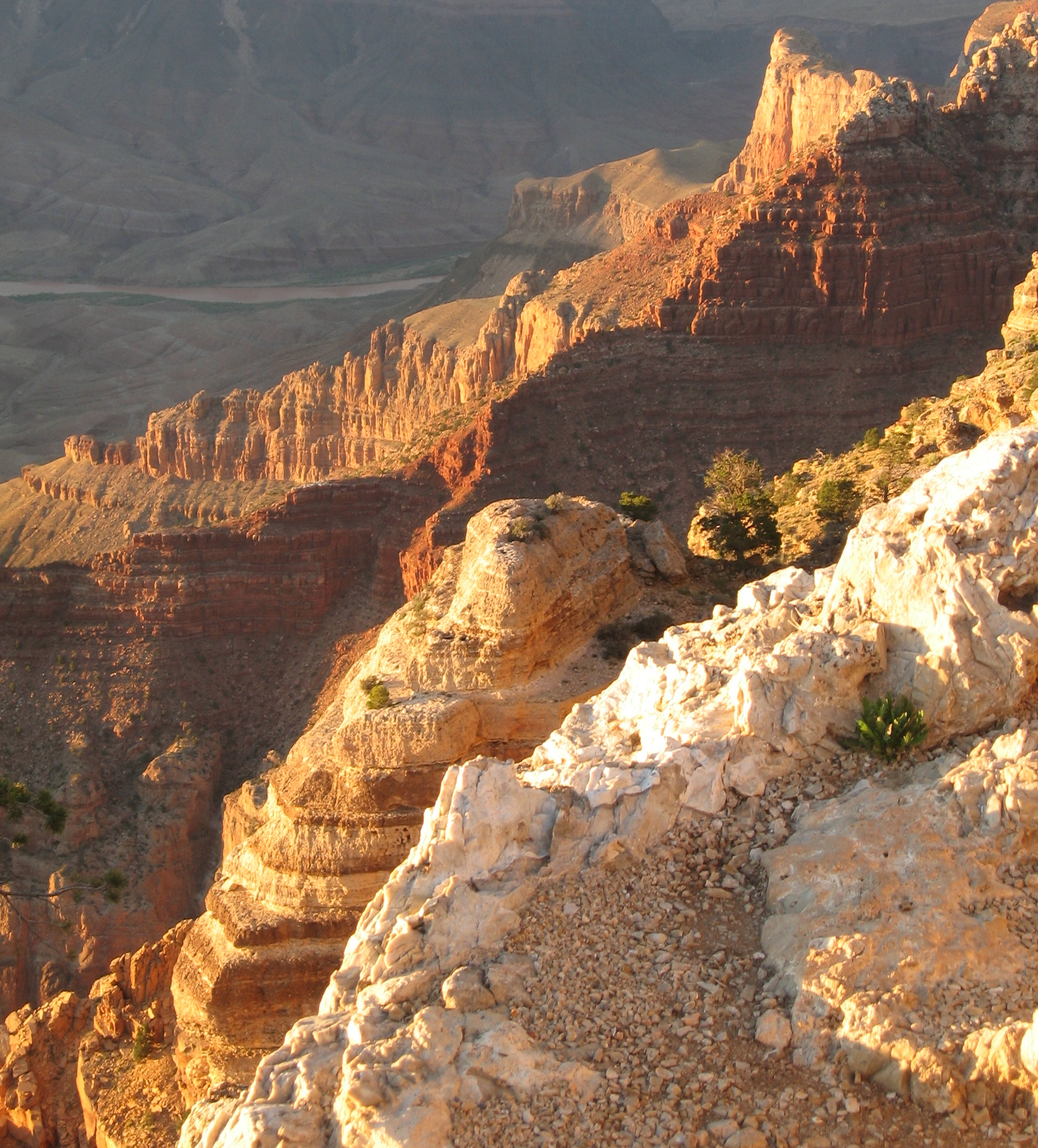
Hourly, I feel her wounds.
Not a day goes by that
I don’t doctor her cuts.
And I ask, “Who are these merchants of death
who profit from the arms,
that turn to dust
the temples of Palmyra.
Who profits?”
For therein lie the secrets and the power.
7.

Those who profit,
glory in our walls,
delight in our separation,
bang the drums of celebration of our layers,
their important, their sacred solemnity,
and draw lines on the planet.
8.

So, I walk,
holding conversations with the earth,
stripping myself naked,
dreaming of a world without lines,
a world without walls.
Copyright all photos and text S. A. Ozuna 2015

Dawn sky swirling with the tattered remnants of last night’s storm, clouds capturing and defining color, space, distance. Light, that voluptuous Sonoran storm light perfusing morning chores. Flash of black and yellow, liquid trills of bird call from the corral fence. A welcome pair of new visitors, meadow larks have arrived to announce the morning. The mountains are backdropped in virga black, a rainbow arching across their face. Soft purling of wind flutters the pine needles.
Every day, I hear the earth screaming in pain at the senseless, and unrelenting destruction of her nature. Glacier National Park, soon to be nothing but a historical reference of what glaciers used to be, and the elephants, the elephants keening their death knells, estimated to be gone in 30 years absent radical intervention. These things haunt my waking moments, and writhe through my veins at night. And yet nature is endlessly generous, providing daily moments of precious beauty.
Why write about a shaft of light, a flicker of wing in a world gone mad?? When lives are being lost, when anger and hatred seem to have become the norm.not some unusual rendering of the fabric of society, but every day bread and butter, what does it matter, the chiaroscuro rendering of a morning’s cloud painting?? Why pay attention to a moment.
Because moments matter. Because these fleeting moments of beauty remind us of the integrity of nature, of its intrinsic value. They are a snapshot of nature’s vast soul. They remind us of the difference between grace and destruction. They provide reference markers between routine and possibility. In a world that too often seems to be marching on a one way trip to annihilation, moments of beauty keep me, if not sane, at least marching forward within a sanity zone of tolerance. Moments of beauty restore shreds of hope to my vision of the future. They are the wind beneath my somewhat life battered and aging wings.
 tales from the sonora